Author name: Venitecknew@

Rank on Google AI Overviews
Digital Marketing

How to Rank on Google AI Overviews: The New SEO Playbook for 2026

If you have been searching for something via Google lately, you most likely spotted something new that has appeared on top of the search engine result pages. A pre-prepared summary is provided right after your search query in an attempt to answer your question without the need to go through the links provided. That is Google AI Overview, which has revolutionized not only the way users interact with the Internet but has also transformed search engine optimization as we know it. As a marketer or website owner, you can no longer ignore this development, as it will determine whether or not your website will appear in the search engine result pages in 2026. What Are Google AI Overviews and Why Do They Matter? Google AI Overviews are AI-generated summaries that appear at the very top of search results for a wide range of queries. Rather than showing a list of ten blue links and leaving users to click through and find their own answers, Google now synthesises information from multiple high-quality sources and presents a direct, structured response. The implications of this are significant. Studies conducted since the rollout of AI Overviews show that the click-through rate for traditional organic results sitting below an AI Overview drops substantially. Users get their answer from the summary, and many don’t scroll further. It creates a new challenge and a new opportunity at the same time. The challenge: if your content isn’t being pulled into AI Overviews, you’re essentially invisible for those queries. The opportunity: if you consistently get featured, your brand gains extraordinary exposure, often with your website cited as a source, which still drives high-quality traffic. The businesses and content creators who understand how to optimize for this new layer of search are the ones who will dominate organic visibility in 2026 and beyond. How Google Decides What Goes Into AI Overviews However, before discussing the tactics for success in AI Overviews, one needs to discuss the selection criteria. First of all, the content that makes its way into Google’s AI Overviews isn’t selected arbitrarily. Google’s algorithm prioritizes content with certain characteristics, which forms the core of the whole approach. The New SEO Playbook: What You Need to Do in 2026 1. Build Content Around Questions, Not Just Keywords SEO of old was mostly keyword-based – getting the right terms into your website and ensuring the proper density. But now, AI-powered SEO means having to think in a new way. Consider the actual way that humans pose their queries, either verbally or in a Google bar. Do they just ask for “best running shoes”? No, they will ask, “What are the best running shoes for flat feet in 2026?” Your content must match their question formulation. Map out the specific questions your target audience is asking about your industry. Build dedicated content pieces around each question. Use tools like Google’s People Also Ask section, Answer The Public, and your own customer support data to find the real questions people are searching for. Then answer those questions clearly, directly, and early in the content within the first two paragraphs wherever possible. 2. Structure Your Content for Machine Readability It is probably the easiest change you can implement in your content. The AI system at Google will find it easier to extract information from a well-formatted website. What does this mean for you? You need to have clear headings (H2 and H3) that tell exactly what each section is about. You should write brief paragraphs as opposed to long sections of text. Use lists when listing processes and things to do, or compare something. Write a summary and key takeaways section. Ensure that you have an excellent FAQ section at the bottom of each page. FAQs are especially important because they match what the AI system is currently doing. Schema markup will come in handy at this point. You should have FAQ Schema Markup, Article Schema Markup, and How-to Schema Markup. 3. Establish Real Author Authority One of the clearest signals in the AI Overview selection process is authorship authority. Google wants to know who wrote the content, whether that person knows what they’re talking about, and whether they have a demonstrable track record. It applies to organizations because it will require you to attribute your blog post or article to actual, named authors. In addition, include author bios that will highlight their qualifications and experience in the field. As an alternative to having all articles posted under the same organizational account name, you can ask your organization’s executives to write an article within their areas of specialization. It connects directly to the broader concept of (E-E-A-T) Experience, Expertise, Authoritativeness, and Trustworthiness. It has been Google’s quality framework for years, and it now feeds directly into which content gets elevated into AI-generated responses. 4. Go Deep on Topics – Not Wide A common mistake in content strategy is publishing a large volume of short, surface-level articles, hoping to cover more ground. In the context of Google AI search ranking, this approach backfires. The AI system recognises shallow content and excludes it in favour of sources that demonstrate genuine depth and understanding. Instead of ten 500-word blog posts covering ten different topics lightly, consider writing three 1,500-word pieces that genuinely exhaust what there is to know about three specific subjects. Cover the main topic, the related questions, the common misconceptions, the nuances, and the practical applications. Be the most thorough resource on that topic that exists online. This pillar content strategy, building comprehensive, authoritative pieces on core subjects, is one of the most effective ways to earn consistent AI Overview citations. 5. Refresh and Update Existing Content Regularly AI Overviews show a clear preference for content that is current and up to date. An article that was written in 2022 and hasn’t been touched since is significantly less likely to appear in an AI-generated summary than one that was recently reviewed, updated, and republished. Review your current content library for anything that may

artificial intelligence

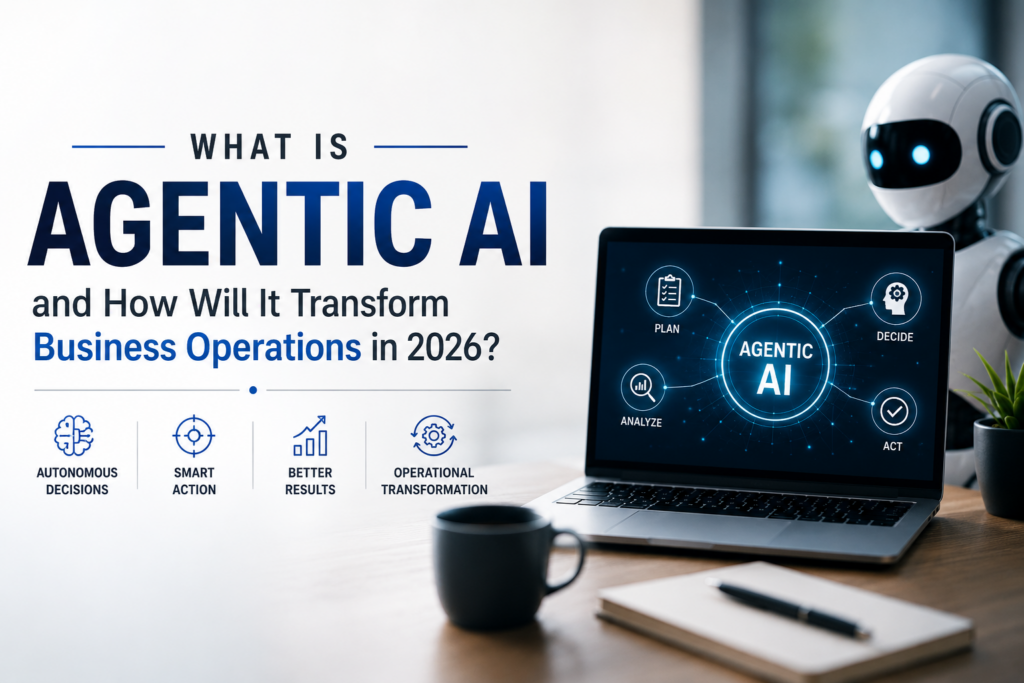
What Is Agentic AI and How Will It Transform Business Operations in 2026?

There’s a term that keeps coming up in every serious technology conversation right now: Agentic AI. You’re hearing it from startup founders, enterprise CTOs, digital consultants, and innovation teams across every major industry. And unlike most tech buzzwords that fade after a quarter or two, this one is backed by something real. Agentic AI represents a genuinely different approach to how artificial intelligence in business gets applied — not as a tool you prompt and wait for, but as an intelligent system that thinks ahead, makes decisions, and takes actions on your behalf. For those who own businesses, manage teams, or want to stay relevant in 2026, here is the idea that you need to know. This blog post provides an understanding of what this idea is, how it works, and how it will transform organisations. Let’s Start With the Basics – What Is AI as We’ve Known It? To understand what makes Agentic AI different, it helps first to understand what most AI tools have been doing up until now. The AI most businesses have used over the past few years is essentially reactive. You give it an input, a prompt, a question, or a data set, and it gives you an output. A chatbot answers a customer query. A language model drafts a marketing email. An analytics tool summarises a report. Each of these interactions is isolated. The AI does what it’s asked, and then it waits for the next instruction. It has been genuinely useful. But it still requires a human to sit in the middle of every workflow, directing the AI at each step, reviewing the output, and then deciding what happens next. Agentic AI changes that model completely. So What Is Agentic AI and How Does It Work? Agentic AI refers to AI systems that can autonomously pursue goals over multiple steps without needing a human prompt at every step. Instead of waiting to be told what to do next, an agentic system is given a goal and then figures out the sequence of actions required to achieve it, executes those actions, monitors the results, adjusts its approach based on feedback, and keeps going until the objective is met. Think about how different the operations of a calculator are from those of a financial advisor. The calculator carries out whatever it is told to do step by step. The financial advisor knows what to achieve, gathers information, makes decisions, makes transactions, evaluates outcomes, and then adjusts accordingly. An agentive AI functions similarly but is quicker and can multitask. From a technical point of view, an agentic AI solution comprises several different layers that include: a language model or reasoning engine that comprehends the objective and context memory that preserves information obtained over multiple sessions planning module that turns objectives into actionable tasks ability to use external tools, including other computerized systems When all of these components are integrated, you have an AI system that doesn’t just answer questions; it gets things done. Why 2026 Is the Inflection Point The idea of autonomous AI entities has always been present in academic discussions. However, what makes 2026 different from all other years is that technologies have now advanced enough to allow their practical application. Several converging factors have made this year an agentic year for systems to move from pilot projects to core business infrastructure. Model capability has reached the threshold where reasoning, planning, and multi-step task execution are reliable enough for production environments. The tooling and infrastructure for connecting AI agents to business systems, databases, APIs, communication platforms, and workflow tools have become significantly more accessible. And the competitive pressure from early adopters has created urgency for businesses that haven’t yet started their agentic AI journey. The organisations that began experimenting with autonomous AI systems in 2024 and 2025 are now achieving meaningful productivity gains. The gap between those organisations and their competitors is widening every month. Agentic AI Use Cases in Business – Where Is It Actually Being Applied? It is where the concept gets tangible. Across industries, agentic systems are being deployed to handle tasks that previously required significant human time and coordination. Here are the most impactful applications happening right now: 1. Customer Service and Support Operations Traditional AI chatbots handle simple queries and escalate more complex ones to a human agent. An agentic system does significantly more. It can handle the initial query, retrieve the customer’s account history, check the relevant policy, generate a resolution, process a refund or replacement request, update the CRM record, send a confirmation to the customer, and flag any patterns it notices for the human team, all without a human touching the process. Resolution times that previously took hours are compressed to minutes. 2. Sales Pipeline and Lead Management Sales teams spend a disproportionate amount of time on administrative tasks, logging calls, updating CRM entries, scheduling follow-ups, researching prospects before calls, and drafting outreach emails. An agentic system handles all of this in the background. It monitors pipeline activity, identifies which leads need follow-up and when, personalises outreach based on prospect behaviour and context, and surfaces the highest-priority opportunities to the human salesperson at the right moment. The human does the relationship work. The agent handles everything else. 3. Finance and Accounting Workflows Activities such as invoicing, reconciling expenses, scheduling payments, verifying compliance, and reporting on finances all follow rules and entail considerable volume. Agentic systems are well-suited to this type of environment. A finance agent can be used to monitor new invoices, compare them against purchase orders, flag any differences, make payments when authorized, record information about these events, and report exceptions. 4. Software Development and Testing Development teams are deploying agentic systems that can read a task from a project management tool, write the relevant code, run automated tests, identify and fix failing tests, update documentation, and submit a pull request for human review. What previously required hours of developer time for routine tasks is being handled autonomously, freeing engineers to focus on architecture,

AI-Powered Cyberattacks Work
cybersecurity

How AI-Powered Cyberattacks Work – And How to Defend Your Business Against Them

Something strange has been happening in the cybersecurity world lately. Quietly, almost in the background, AI-powered cyberattacks have started showing up in places businesses never expected. Small companies. Mid-sized firms. Even local service providers in India and Australia. Not just big corporations anymore. Not too long ago, cybersecurity risks seemed to be a problem only for banks and tech companies. Now, a shop in Bengaluru can become the victim of an attack. A company in Melbourne might wake up without any system access. In some cases, an innocent-looking email is enough. Other times, it could be a fraudulent login page, even in cases where nothing seems out of place initially. That’s the unsettling part. You don’t always see it coming. And honestly, many business owners still assume cyberattacks are random, like bad luck. But they’re not. Most of them are carefully planned, increasingly automated, and surprisingly intelligent. Let’s talk about how this actually works — in plain language, not technical jargon — and what businesses can realistically do to stay safe. The Shift From Manual Hacking to Intelligent Attacks Cyberattacks used to be messy. Someone would try guessing passwords, sending spam emails, or poking at servers, hoping something would break. It required effort. Time. Skill. AI changed that rhythm completely. Today, hackers don’t just sit around testing systems manually; they create Custom software that can identify patterns, scan through many networks, and find vulnerabilities more quickly than any person can. It’s almost like having an automated assistant… but one that’s trying to hack your company. And it works because businesses are predictable. Employees reuse passwords. Teams click links when they’re busy. Systems run outdated software longer than they should. AI watches these patterns and adapts. And that makes the entire situation quite awkward when you stop to think about it. A Simple Breakdown of How Attacks Actually Happen Most people imagine hackers typing aggressively in dark rooms. Reality is much quieter. More structured. Here’s how AI-powered cyberattacks work in everyday business environments. First, attackers gather data. Public websites, social media profiles, company directories — anything available online becomes useful. AI tools scan this information and build a profile of the business. Then comes vulnerability scanning. Automated systems check software versions, email structures, and login portals. After that, the system determines the easiest entry point. In most cases, this is an email. In some cases, this is cloud software. In a few cases, this is the employee’s login credentials. And once the system is inside… The AI system will continue to learn and monitor the behavior. It will monitor the flow of the data. It will continue to penetrate the system without setting off any alarms. No alarms blare. No crashes occur. It is what makes modern cyber threats different. They are patient. Phishing Emails Are Getting Uncomfortably Real There was a time when phishing emails were easy to spot: broken grammar, weird links, strange requests. You could almost laugh at them. Not anymore. AI-generated emails now mimic real writing styles. They copy tone, sentence structure and even company branding. An email might look like it came from your manager or a vendor you’ve worked with for years. Imagine receiving a payment request that sounds exactly like your finance head. Same signature. Same language. Same formatting. Would you question it? Probably not. In India, businesses have already experienced instances where fake vendor emails were used to divert payment to unknown accounts. In Australia, there were instances of small service businesses that were affected by invoice fraud attacks. The scary part of all this isn’t the attack itself. It’s how believable it all feels. Automated Password Attacks Are Faster Than Ever Passwords are still the weakest link. Everyone knows this, yet it keeps happening. AI systems can now test thousands of password combinations in seconds. They analyze leaked data from past breaches and predict likely password patterns. People tend to repeat habits — birthdays, simple words, slight variations. Attackers know that. So instead of guessing randomly, AI predicts likely combinations and tries them automatically. It’s less guessing, more calculation. And sometimes it works disturbingly fast. That’s why businesses are starting to take authentication more seriously. Not because they want extra steps, but because basic passwords just aren’t enough anymore. Small Businesses Are Becoming Easier Targets There’s a common belief that attackers only go after large corporations. That belief is outdated. Smaller businesses may not have robust cybersecurity systems, which makes them vulnerable. They are easier targets because they have less security, less monitoring, and less awareness. It’s like locking a house. A thief may not steal from a big house. He might steal from a house with an open window. That’s what’s happening in many small and mid-sized companies across India and Australia. Attackers prefer easier access, not bigger headlines. It’s not personal. It’s practical. Data Theft Is No Longer the Only Goal Earlier, attackers mostly wanted data — customer details, payment information, internal documents. Now the goals are expanding. Some attackers lock systems and demand ransom. Others manipulate financial transactions. Some quietly monitor business operations to sell insider information later. The motivations vary : And sometimes businesses don’t even realize they’ve been compromised until weeks later. Which is unsettling, honestly. The Role of Human Error in Modern Cyberattacks Technology is blamed a lot, but the human factor is still a huge part. Someone clicks on a suspicious link. Someone downloads a file they don’t recognize. Someone doesn’t install a software update. These are small actions. But the consequences are big. The AI doesn’t always try to force its entry. Sometimes, it waits for a mistake. In many actual cases, the employee doesn’t realize they’re letting the AI in. Busy schedules, tight deadlines, and constant emails make it easy to overlook warning signs. That’s why awareness training is becoming just as important as technical protection. People need to recognize risks before they happen. Why Businesses Are Turning to Security Experts At some point, most companies come to realize that they cannot

what are the top software development trends in 2026
Software Development

Top Custom Software Development Trends Businesses Must Follow in 2026

The conversation around custom software development trends 2026 has quietly shifted over the past year. Not dramatically. Not overnight. Just… gradually. Businesses in India and Australia, especially mid-sized ones, are no longer chasing flashy tech for the sake of it. They’re asking simpler questions now — Will this save time? Will this reduce costs? And to be honest, that change feels good. For a long time, companies thought they had to keep up with software, but they didn’t actually use it comfortably. Teams had a hard time with tools that looked good but didn’t work in real life. Managers kept changing platforms. Developers kept changing the systems. It’s a little tiring. Now things are different. Not quickly, but in a way that matters. Let’s talk about the big changes that will change how businesses use software in 2026. These are the kinds of changes that will make a difference in the real world, not just at tech events. 1. AI Takes the Backseat, Rather Than Being an Overwhelming Feature AI was once seen everywhere. It was in every product, talked about in every sales pitch, and labeled as “smart” on every dashboard. Now something fascinating is beginning to happen. Companies are no longer asking, “Does this software have AI?” They’re asking, “Does this software make work easier?” That’s where AI in software development is settling into a more practical role. It’s less about hype and more about small, helpful actions : Not much is happening. It just works. AI is helping software developers in India do less repetitive coding. It is helping logistics and health care companies in Australia automate their reports and schedules. Different sectors, but one common principle – AI needs to help, not take over. And honestly, that feels like progress. 2. Businesses Want Software That Fits Them – Not the Other Way Around There was a time when companies adjusted their workflow to match software. Now they expect software to adjust to them. It is where custom software development becomes more relevant than ever. Off-the-shelf tools still exist, of course. They’re quick to deploy and relatively affordable. But they often come with limitations — fixed features, unnecessary modules, and processes that don’t match real operations. Custom-built systems, on the other hand, allow businesses to : In Australia, many small and mid-sized businesses are moving away from rigid SaaS tools. In India, growing enterprises are building internal platforms to handle complex operations. Not because it’s trendy. Because it works better. 3. Industry-Specific Software Is Taking Over Generic Platforms Generic platforms are losing their appeal. Think about it. A construction company doesn’t operate like an e-commerce store. A dental clinic doesn’t run like a logistics firm. A driving school doesn’t function like a retail brand. Yet for years, many businesses tried using the same general tools. Now, they want software built for their industry. This shift is subtle but powerful. Industry-focused solutions help businesses : And it’s logical. The software needs to be user-friendly rather than perplexing. Firms from both nations have come to understand that generic software causes resistance, whereas specialized software eliminates it. Simplicity sometimes wins. 4. Cloud-Native Development Becomes the Standard Cloud is no longer a future concept. It’s normal now. Businesses expect their software to work from anywhere — office, home, warehouse, or even while traveling. Cloud-native systems offer : Small businesses in India are adopting cloud systems to avoid expensive hardware. Australian companies are using cloud environments to manage distributed teams and remote operations. There’s also a comfort factor here. No one wants to have to worry about servers going down or losing important data. Cloud-based software takes that fear away. Quiet dependability. That’s what makes it so appealing. 5. Security Becomes a Business Issue, No Longer an IT One In the past, security was purely a technical issue. Now it is a business one. Data security, privacy laws, and cyber threats have made companies careful about securing information. Smaller companies are also concerned about protecting their own data through software. That is impacting the way we develop software in 2026 : In Australia, data protection laws are pushing companies to take security seriously. In India, digital growth is making businesses more aware of cybersecurity risks. The mindset is simple: If software handles business data, it must be secure from the start. Not added later. Not patched after problems appear. From the beginning. 6. Integration Is Becoming More Important Than Features Here’s something many businesses have learned the hard way. Having multiple software tools is fine; having tools that don’t talk to each other is a problem. Sales software, accounting tools, CRM systems, HR platforms — everything needs to connect smoothly. It is where custom software solutions help reduce operational friction. Instead of jumping between different platforms, businesses can connect everything into a single ecosystem. That means : In India, companies that are growing quickly use integrations to handle growth. In Australia, service-based businesses like unified systems because they make things easier. It’s not fun to have to switch between five dashboards every day. It feels better to have one system that connects everything. 7. Local Market Understanding Is Becoming a Major Advantage Global software companies offer large platforms, but they often miss local business realities. Different regions have different needs. Payment systems vary. Regulations differ. Customer behavior changes from place to place. That’s why regional development teams and local tech providers are gaining importance. A software development company in Melbourne might know more about Australian compliance rules than a company that works all over the world. Indian development teams also often make systems that are perfect for local businesses that are growing quickly. Local knowledge leads to useful solutions. Not ones that are just ideas. And businesses are noticing this difference more than ever. 8. Speed of Development Is Now a Competitive Factor Time matters. Businesses don’t want to wait a year for software deployment anymore. They want faster development cycles and quicker updates. Modern development practices are making this possible

Scroll to Top