
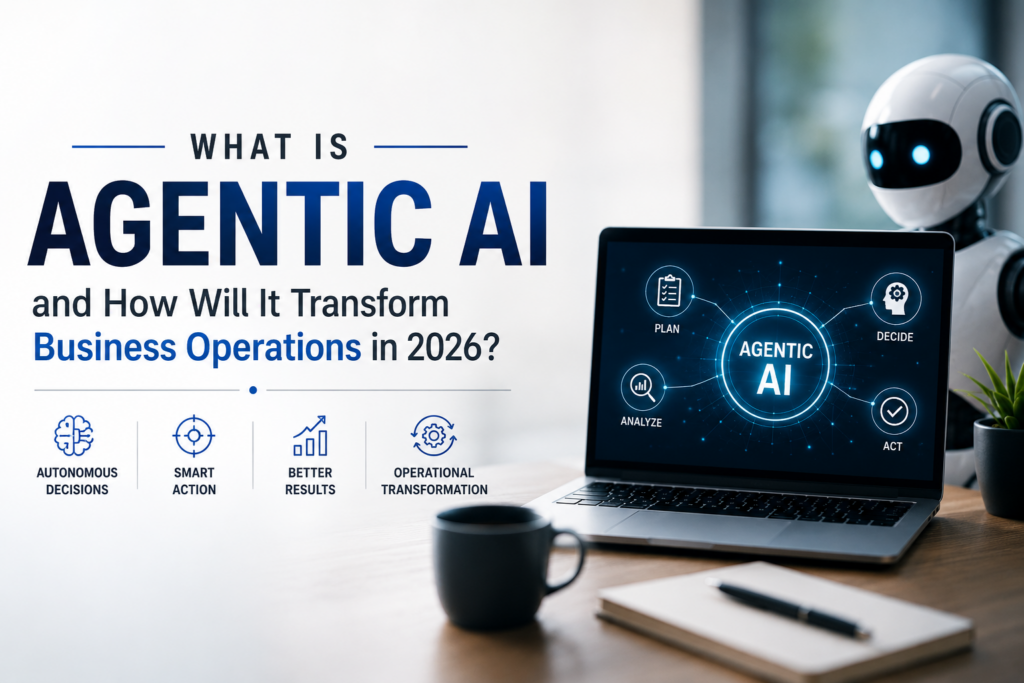
What Is Agentic AI and How Will It Transform Business Operations in 2026?
There’s a term that keeps coming up in every serious technology conversation right now: Agentic AI. You’re hearing it from startup founders, enterprise CTOs, digital consultants, and innovation teams across every major industry. And unlike most tech buzzwords that fade after a quarter or two, this one is backed by something real. Agentic AI represents a genuinely different approach to how artificial intelligence in business gets applied — not as a tool you prompt and wait for, but as an intelligent system that thinks ahead, makes decisions, and takes actions on your behalf. For those who own businesses, manage teams, or want to stay relevant in 2026, here is the idea that you need to know. This blog post provides an understanding of what this idea is, how it works, and how it will transform organisations. Let’s Start With the Basics – What Is AI as We’ve Known It? To understand what makes Agentic AI different, it helps first to understand what most AI tools have been doing up until now. The AI most businesses have used over the past few years is essentially reactive. You give it an input, a prompt, a question, or a data set, and it gives you an output. A chatbot answers a customer query. A language model drafts a marketing email. An analytics tool summarises a report. Each of these interactions is isolated. The AI does what it’s asked, and then it waits for the next instruction. It has been genuinely useful. But it still requires a human to sit in the middle of every workflow, directing the AI at each step, reviewing the output, and then deciding what happens next. Agentic AI changes that model completely. So What Is Agentic AI and How Does It Work? Agentic AI refers to AI systems that can autonomously pursue goals over multiple steps without needing a human prompt at every step. Instead of waiting to be told what to do next, an agentic system is given a goal and then figures out the sequence of actions required to achieve it, executes those actions, monitors the results, adjusts its approach based on feedback, and keeps going until the objective is met. Think about how different the operations of a calculator are from those of a financial advisor. The calculator carries out whatever it is told to do step by step. The financial advisor knows what to achieve, gathers information, makes decisions, makes transactions, evaluates outcomes, and then adjusts accordingly. An agentive AI functions similarly but is quicker and can multitask. From a technical point of view, an agentic AI solution comprises several different layers that include: a language model or reasoning engine that comprehends the objective and context memory that preserves information obtained over multiple sessions planning module that turns objectives into actionable tasks ability to use external tools, including other computerized systems When all of these components are integrated, you have an AI system that doesn’t just answer questions; it gets things done. Why 2026 Is the Inflection Point The idea of autonomous AI entities has always been present in academic discussions. However, what makes 2026 different from all other years is that technologies have now advanced enough to allow their practical application. Several converging factors have made this year an agentic year for systems to move from pilot projects to core business infrastructure. Model capability has reached the threshold where reasoning, planning, and multi-step task execution are reliable enough for production environments. The tooling and infrastructure for connecting AI agents to business systems, databases, APIs, communication platforms, and workflow tools have become significantly more accessible. And the competitive pressure from early adopters has created urgency for businesses that haven’t yet started their agentic AI journey. The organisations that began experimenting with autonomous AI systems in 2024 and 2025 are now achieving meaningful productivity gains. The gap between those organisations and their competitors is widening every month. Agentic AI Use Cases in Business – Where Is It Actually Being Applied? It is where the concept gets tangible. Across industries, agentic systems are being deployed to handle tasks that previously required significant human time and coordination. Here are the most impactful applications happening right now: 1. Customer Service and Support Operations Traditional AI chatbots handle simple queries and escalate more complex ones to a human agent. An agentic system does significantly more. It can handle the initial query, retrieve the customer’s account history, check the relevant policy, generate a resolution, process a refund or replacement request, update the CRM record, send a confirmation to the customer, and flag any patterns it notices for the human team, all without a human touching the process. Resolution times that previously took hours are compressed to minutes. 2. Sales Pipeline and Lead Management Sales teams spend a disproportionate amount of time on administrative tasks, logging calls, updating CRM entries, scheduling follow-ups, researching prospects before calls, and drafting outreach emails. An agentic system handles all of this in the background. It monitors pipeline activity, identifies which leads need follow-up and when, personalises outreach based on prospect behaviour and context, and surfaces the highest-priority opportunities to the human salesperson at the right moment. The human does the relationship work. The agent handles everything else. 3. Finance and Accounting Workflows Activities such as invoicing, reconciling expenses, scheduling payments, verifying compliance, and reporting on finances all follow rules and entail considerable volume. Agentic systems are well-suited to this type of environment. A finance agent can be used to monitor new invoices, compare them against purchase orders, flag any differences, make payments when authorized, record information about these events, and report exceptions. 4. Software Development and Testing Development teams are deploying agentic systems that can read a task from a project management tool, write the relevant code, run automated tests, identify and fix failing tests, update documentation, and submit a pull request for human review. What previously required hours of developer time for routine tasks is being handled autonomously, freeing engineers to focus on architecture,